Sunday, January 24, 2016

January in the garden - its all about LEAVES

OK, maybe it's not ALL about leaves. You can see some lemons in the background and, thanks to global warming, some nice fresh Serrano chillis in the middle of January in the Bay Area. Its just a shame that my digestive tract doesn't really appreciate these as much as I do.

But now back to the stars of the season - plants that are really difficult in the heat of summer. Plants that love moisture and dont require intense sunshine to prosper. The leaf plants.

We are talking (1) Lettuce - for example, black-seeded Simpson lettuce, very floppy leaves that provide a nice, sweet, bland background to any salad. The color really pops in any garden and livens up the place no end. Go wild - plant them in your winter flower beds for some welcome color.
Here, the green of the lettuce is set against a lovely red-leafed mustard plant. These mustards develop really large leaves - this one is called "Red Giant". Both of these plants were sown in late November, and are now being harvested for the bigger leaves, letting the smaller leaves continue to develop.

The kale in the same  bed is about 2-3 feet high and is at least one year old at this point; when the kale starts looking a little old or about to flower or is insect-infested, I just lop the tops off, and they then sprout fresh from the stump. The plant pictured is now growing on two levels - a head at the top, and a few smaller heads near the base. For crop rotation reasons, I'll probably pull it up this summer, but it looks like it could go on forever. I have about 15 plants here and there in the garden, and I harvest a good bunch every time I feel like cooking it. In between, the plant harvests itself by dropping lower, yellow leaves. My previous attempts with Laciniato kale were rather mixed, but this plain old curly kale seems to do rather well. Or maybe its just the age of the plant. I'm still going to work on the laciniato because I prefer it; one thing is that I'm adding some simple fertilizer to the greens, not just using compost, so that might be some of the improvement. The second is that the soil is getting better as the compost builds up in it. A third reason is that we are in an El Nino, and the garden is getting lots of water right now.
 Here is another batch of kale, some of these are younger and smaller. This is a good example of how I like to plant - close spacings, and mixing different varieties. Here there are kale, chard, onion and fava beans, with some lettuce, mustard, cilantro, chinese celery and parsley here and there. This confuses pests searching for their host plant. Or so they say - its certainly not foolproof. But so far this winter, I have had very few pest problems, perhaps because the insects are in hibernation.


Monday, January 18, 2016

Mushroom Time

 We have finally had some decent rains, and mushrooms are coming up all over. To the left is a Lepista Nuda, the Wood Blewit, a pretty good-tasting edible mushroom. This specimen lacks a lot of the pretty purple color that is found at the base of the stem and in the gills of young specimens. But the cap has that nice light brown, and its growing in a spot that I know produces blewits, so I fried it up. The smell is very earthy, woodsy.
 To the right, we have what I first thought might be a Caesar mushroom - supposedly very good eating, but because I dont know this species, I looked it up. Good thing I did. The Caesar mushroom is an Amanita, like the deadly Death Cap and the red/speckled white fairy-sitting-on-the-top mushroom. Accordingly, it should have been growing out of something looking like an egg (the volva). As you can see, no such stem base existed. A little searching revealed it to be a Hygrocybe
Here it is growing in the lawn. Notice the black stain on the top of the cap, and in the picture above, at the base. If you cut or bruise the stem more (as I did), it turns pretty black. In the picture above, you can also see that the cap is quite slimy, as is the stem, although you cant see this in the picture. These are pretty diagnostic of:


Hygrocybe singeri is essentially a slimy-stemmed version of Hygrocybe conica. Like its more familiar cousin, Hygrocybe singeri discolors black and has a brightly colored, conical cap. But while the stem of Hygrocybe conica is dry or faintly greasy, the stem of Hygrocybe singeri is truly slimy, making it difficult to pick.

Not generally poisonous (although some close cousins might be), but not generally edible. Tossed onto the compost heap.  The common name is "Witch's Hat".

Saturday, March 7, 2015

Endless Salads

It has been a good spring so far; this year, I discovered mustard greens. They grow well in winter, make huge leaves, which add spice to salads, and can also be cooked like spinach. I prefer them raw. However, mustard greens is not all I have been eating. The rocket, as usual, is doing well from its self-sowings, and crops of parsley and cilantro are also doing well. All of these seed themselves and look after themselves. The lettuce, of course also did well, but this I tend to block sow in pots, transplant into small posts, and then put into the soil when bigger. I also have a red lacy mustard that looks nice in a salad, and when you put all of the above together, I have been eating a big green salad every day for 2-3 months now.

In this bed, you can see curly kale (blue-green), dill (feathery), mustard greens (light green, rounded leaves), and other salad greens (endive salady thing on the bottom left, black-seeded Simpson lettuce on the top right).  I like to mix the plants like this, because they each take different nutrients from the soil; however, I'm aware that this is not the best thing to do from a crop-rotation perspective.

For those who think that global warming is a myth, you can see I'm harvesting bell peppers in Feb-March. Admittedly, the fruit are not growing much in the winter, but the plants are overwintering nicely outside. I have now re-potted these plants into larger pots, and I'm hoping that as the weather warms up, these plants will resume growth and make even larger plants this year.


Moles.


All winter long, I was wondering what those molehills were; not being native to this area, but to Europe, I would have said they were due to moles if I lived in the UK, but here? They could be anything for all I knew. Gophers, perhaps. Giant termites. Anything.
Anyway, the mystery was solved today, when I caught one accidentally while filling a pot with home-made compost. One of the chunks squeaked and quickly re-buried itself.

So here it is, in all its glory; an Almaden Valley mole.

Moles eat worms, grubs, insects and so on, mainly, so they won't be attacking my plants directly. They will, however, cut down on some pests - grubs, slugs, snails - and till and aerate the soil. So this little new acquaintance went back into the compost pile.

What you see of the tail in the picture is all there is; about an inch. Spade-shaped front paws, big nose. Lovely fur.

Tuesday, June 3, 2014

Squash Bug Alert!

Alas, the creepy-crawlies are once again beginning their assault on the garden.  Squash bugs infest, as you might have guessed, members of the squash family, to wit, Zucchini. Also pumpkin, but that's not a big problem for me because I don't grow pumpkins.

The life cycle of the squash bug is basically to come out of hiding when the Zucchini plants start to flower, lay loads of small coppery oval eggs in the wedges between the veins on the underside of the leaves, which then hatch into a load of absurd lime-green pinheads with black legs, which then molt into grey things, and then become the black thing you see pictured above, all in about 6-8 weeks. At which point they mate, restart the cycle, and any bugs that make it to adulthood by early fall then scurry away and hide in the underbrush until next spring/summer.

If you manage to kill all the adults at the start of the season, you should hopefully get a pretty good start on nipping the problem in the bud, or at least until the next generation flies in from the neighbor's.

Last week, I saw two mating on my plants for the first time, then the next day I found about 15, then 2, then 1, and today, none. So I would guess that right now is a good idea for people in Almaden Valley to be checking their Zucchini plants for these bugs.

The simplest way to find them is to water the plants in a decent shower; the bugs then like to climb the stems to get away from the water at ground level, and you get to see them more easily on the stems and under the leaves, and their movement helps too.  They are easily killed, and the name "squash bug" finds a double entendre in my garden. I have read that watering the plants with water including squashed bugs helps to repel others, but I have also read that you shouldn't squash the bugs because they release a pheromone that attracts more.  While it is true that they stink (I find it a slightly pleasant smell, but I can understand how others might consider it a "stink" bug), I have no idea if this affects populations. In the end, I decided that attracting more is not a bad thing, because it means I get to squash more of the population in the area at once. But the jury is out as to whether it makes any difference. If you don't like squashing, just drown in soapy water.

However, it is CRUCIAL to not let these breed. Once they breed, you have hundreds of these larvae things running everywhere, and these bugs kill the plants as they lacerate and block juice tubes in the plant. The leaves wither and die, and finally, the last few Zucchini are covered in these pests. So act with haste and pre-emption. Inspect your plants now, kill the adults, then continue to inspect the leaf undersides for masses (about 25 in each) of coppery eggs, and squash or cut these out and destroy. For now, every time you water the plants, look closely at the plants immediately after and look for these bugs.

My Zucchini season started today, when I picked a fairly small one. It didn't seem to be growing rapidly, maybe because it wasn't fully pollinated, or maybe because the plants don't have enough energy yet, so I just broke it off and ate it. I see more following. Cherry tomato, blackberry and apricot seasons are also at their start right now. So far, its only the early outliers, but it harbinges well. Is that even a word? Harbinges? If there is a harbinger, it must harbinge, right?


Friday, May 9, 2014

Free Potatoes

Last winter, a few potatoes in the bag were growing sprouts, so I thought, "Hey, why not throw these in the garden and see what they do". Not only are potatoes relatively easy to grow, but they help to clear the ground of weeds; however, my main though was simply filling some empty space, adding a little crop rotation, and seeing how well they would do in this climate.
At the start of May, the haulms (stems) were looking limp and fallen over, so I thought I'd have a look and see how the potatoes were doing underneath. Imagine my surprise when I found about 5 decent spuds under each one. Thats a 500% return in about 5 months - not bad.
Of course potatoes are cheap in the grocery store, which is why I never really bothered with them until now, but there are several advantages of growing them yourself; 
First, when I buy potatoes in the grocery store, I usually eat more than I want to simply because I dont want to waste them before they go green/bad/sprout. Even then, I usually end up throwing out the last few. Having them in the garden means I can harvest just as many as I need, leaving the rest in the ground for later, so there is no waste. 
Second, the potatoes I harvest are new potatoes, which you cant get in the stores here, other than perhaps as a specialty item, for which you pay through the nose.

So for those in the Almaden Valley and similar climates near here, I'd recommend growing potatoes as follows:
(1) In Winter - anytime in November, December, January, February - if you find any potatoes sprouting in your store-bought bag, simply dig a hole in the garden, about 4-6 inches deep, and throw the potato into it and re-cover. 
(2) If you have compost (not fancy stuff, just stuff from the compost pile that is reasonably rotted), throw over the surface when you are done. This is just a convenient time to be adding compost anyway, because you're not meddling too much with plants on the surface in winter.
(3) Plant more potatoes as they become available, until you have one for every 2-person meal you're likely to want, each about a foot away from the other. Allow about a foot and a half on either side as the stems will probably fall on top of anything growing there.
(4) If you want, you can plant other winter crops in between while the potatoes get going; you should be able to get a crop of lettuce in, for example, before the potatoes smother them.
(5) Harvest from the end of April onwards, as needed in the kitchen. Remember to throw the stems on the compost pile.
(6) As long as you dont grow too many and keep growing them in the same location, year after year, you probably shouldnt get too many diseases/pests showing up. It also helps to interplant with other crops. I had some spring onions, lettuce and parsley mixed in with mine (and the bed is bounded by herbs like lemon balm and oregano).

For 5 minutes work and kitchen waste, you get a meal for 2 of great-tasting potatoes.

Potatoes should also grow well in an old compost pile if you want to let it rot down a little longer or in buckets filled with just-finished compost; they are fairly greedy feeders, so they can handle younger compost than other plants, probably.

In terms of garden management, potatoes work well with compost and/or manure in starting off the crop rotation cycle, in improving the condition of the soil. By growing them in winter, there shouldnt be too many problems in water requirements either.

Saturday, January 5, 2013

Catching up

Alas, I've been very slack in writing this blog last year, so here is a quick summary of last years highlights; First, I largely abandoned the ground gardening last year, simply because it takes so much water, I never do enough watering, and so the plants never do that well; also, all the beds are part-shaded. Of course its hard for me to waste ground, so I did put some stuff in here and there anyway, but I focused most of my gardening into bucket gardening. These buckets were filled with a mix of composts, soil, including the home-made compost from the previous winter. The best part; I get to move the buckets into the middle of the lawn (pretty much bare earth in summer here) so they get lots of light, and I even get to move them around to catch the sun if needed. Each bucket got punched with a nail several times so they drained, and then were planted. Most buckets last year got one or another tomato variety, and most did well, although there was an issue with a garden rat picking off all the early tomatoes until I filled the bite marks with ghost chili sauce. After trying to pick around the sauce for a while, eventually the rat gave up. It also helped that I found where he hid out during the day and hosed the place out. But all told, the rat probably got about 30 tomatoes or more. Possibly he was using the tomatoes as a water source, so one of my strategies was to leave a water source in a corner of the garden so he had a choice. I also noticed that he ate into my recycling plastic bottles, again looking for water. I really dont mind pests taking a little here and there, but when I lose almost every tomato for a few weeks after months of caring for them, it gets a bit much. Into the buckets also went basil, lettuce, eggplants and cucumber; these had very few problems; rats apparently dont like cucumbers, possibly because the leaves are rough and hairy. The crop wasnt massive (I only had 2 plants), but it gave a good enough show, so I'll definitely be growing some again this year, maybe different varieties. Last year I got cucumbers that were more like dill pickles. The one problem that these shared with the eggplants was that both tended to be bitter, so some were OK, others not. It turns out that the standard "black beauty" eggplant has to be picked quite young and gets bitter very quickly. Now that I've worked out eggplant growing - in containers in full sun - its time to try other varieties and see if I can find some that are inclined to be less bitter. The Zucchini crop this year wasnt great, at least in part because I wasnt growing so much in the ground; the ones in the buckets didnt produce as much, and there were fewer plants than last year. I guess this year I need to go back to growing zucchini in the ground; the ground continues to get better with all the compost thats going in, together with the occasional buried fish guts and whatnot. The topsy-turvy tomato containers were as good this year as usual (and safe from the rat), but once again I've lost a couple of containers because they really rot quickly (despite their claims to be reusable for many years). I've got other hanging containers this years, right-side up ones, but I dont suppose that will make much of a difference as the plants will tumble over the edge. The grapevine did very well last year, with about 30 bunches of grapes; I thinned these out a lot, by about half, then harvested the others fairly early to make about a liter of white wine, which so far smells a little yeasty, but I'm hoping this will go away in time. I'm hoping that this harvest didnt damage the vine, because they warn against taking early crops, but the vine was quite big, and I harvested early, so there should have been a lot of nutrients going back to the roots. It's also got a lot of soil to itself. I pruned the vine back around new years, cutting most of the side growths off, and knocking some of the leaders back. Cleaned out the pomegranate a little at the same time. Next post, I'll discuss how the winter crops are doing.

Friday, January 6, 2012

Fava Bean in Flower


First flowers appearing on the Fava beans, on the first sowing made back in Mid-October.


The Kale/Fava/Pea bed looks nice against the Autumn leaves.


This is an experiment in times to plant Favas and Kale (Kale should have been sown earlier, I think; I have only started any reasonable harvesting since Christmas (2 meals), and its still small. We'll see how the Favas go, but the fact that they have flowers is positive. Lets hope there are some bees hanging around, or hummingbirds. This year we havent had much rain yet, I'm watering the crops. The nights are fairly cold, bundle-up weather, but it could be mistaken for spring. I suppose I really should be recording temperatures to do a real experiment.

Its also an experiment in interplanting Favas (provide nitrogen), Kale (use nitrogen, and may help hold up the Favas, and Peas (add support AND provide nitrogen). The idea was supposed to be that the Favas would take over once the Kale was pretty much over, but I think for that, the Kale needs to be planted earlier.

Monday, December 12, 2011

Sprouts


Sprouts still moving along, still mostly about a foot high in general. At this point, it looks like they wont be gracing my christmas table. The Cos Lettuce is likewise not really bulking up that much, so I'll probably start harvesting mid-sized lettuces. I guess with Cos, one is enough for a meal anyway.
The French Breakfast radishes grew thick enough, but still without lenghtening. I'm not sure what it takes to grow longer roots, but clearly planting in a bucket of compost isnt enough.
The Parsley is looking good, already big enough for a leaf here and there. This really makes a good winter crop; its a great green for soups. Last year I often ate ramen noodles with a few parsley leaves thrown in as vegetable.
The beets are still at the 2-leaf stage, but the white turnips are starting to look like radishes, at least in terms of the tops.
The Swiss Chard got knocked by that leaf miner again, but the new leaves look clean so far. I'm hoping the cold weather keeps all these pests down. Similarly, the aphids on the Brussels Sprouts and the caterpillars on the Kale and Sprouts are appearing more infrequently.
The Kale at this point is about a foot high, and I have been doing some very light harvesting of lower leaves. Its looking like Kale is a successful crop here to add to my list. Finally, the Fava Beans are pretty large plants now, most are a foot high or more. I'll continue to plant more to find out whether planting them earlier helps their crop or not.

Thursday, November 10, 2011

Gulf Fritillary


Unfortunately no photo from me for this (the above is from Wikipedia, but was taken in Berkeley), but I spotted a Gulf Fritillary today. Not something I have seen before, and the Bay Area is on the edge of its range.

From Wikipedia:
The Gulf Fritillary is commonly seen in parks and gardens, as well as in open country. Its range extends from Argentina through Central America, Mexico, and the Caribbean to the southern United States, as far north as the San Francisco Bay Area on the west coast. It is occasionally found farther north in the US.

Friday, October 28, 2011

Shogoin Turnip

Tried some Shogoin Turnips today, planted seeds in a bucket left over from the Tomatoes topped up with fresh commercial compost. Lets see how they do over the winter. They are supposed to mature in 45 days, which would be mid-december, but I'm not holding my breath. This is going to be a small crop - even at 2-inch spacing, a bucket wont hold much - but it should be a test of how these things grow at this time of year.

Speaking of which, over the past few days, we have dropped down to cooler temperatures again, from the low 80's to the mid 70's during the day, and cold enough at nights to close all the windows and put a jumper on. Its also been getting darker; I'm switching the lights on inside about 6 pm now, summer time.

I notice the first sowing of Fava Beans has had pretty much 100% germination between the Kale plants, and are now about 3 inches high. The Kale itself is about 6 inches with about 6 medium-sized leaves on each plant - nowhere near harvesting yet, but well-established young plants.

I have noticed a plant disappearing here and there, a Kale or a Lettuce, so I reluctantly hauled out the old metaldehyde. I dont like using poisons, but slugs destroy plants - they dont just nibble. My entire sowing of a lettuce mix by the grape vine, about 12 square feet, has nothing now, just some Nigella, a garlic sprout here or there, and one or two adventurous weeds. Like the sowing of Lettuce, Radish and Carrot where the Leeks are now, I suspect that baby slugs just took out one seedling after another. I have no problem growing from seed in pots, but nothing survives at that stage in the ground. You see a few germinating seeds, then POW! Nothing left. So chemicals it is.

The Cos Lettuce continue to do well, so last week I sowed another few in small pots to replace these ones when the are harvested. Finally, I noticed some bumps appearing in the joints of one of the brussels sprouts, so it looks like these are going to start developing over the next few weeks. The plants are still 6 inches to a foot high, depending on the sowing, but there is a noticeable thickening of the stems to about thumb size.

Thursday, October 20, 2011

October plantings


The Brussels Sprouts are doing quite well now, actually looking like plants, rather than seedlings or plantlets. It has been now since seeding (mid-July), and the stems are starting to thicken a little and lengthen. The weather is quite good, being not too hot, no too cold (70-80°F), and a little light rain here and there (nothing much, so I have to water, but it has evenly dampened the previously baked soil). I'm quite happy that a decent amount of growth has taken place by now, before the cold weather starts.

The leeks were finally put in about a week ago, and are starting to put on some growth. It's about time, because like last year, they have done almost nothing until now. Its as if they wait for replanting to get going, whether thats from soil (last year) or a pot (like this year). Maybe next year I will try seeding earlier in a bucket. In the picture, you can also see some of the Parris Island Cos; that, along with the Kale and Swiss Chard from the same sowing (early September), has all now been planted out, and is looking established, although still small. The space for the leeks was that ealier used for lettuce/carrots/radishes, none of which really did much more than throw up 2 or 3 seedlings.

The Kale you see here was sown earlier, pricked out into small pots, and has finally been planted out. I have planted some Fava Bean seeds and peas among the Kale, with the idea that these can provide nitrogen to the Kale, and take over in early spring when the Kale has all been harvested. I think the Favas are supposed to have deep roots, so they may not interfere with each other that much. Another experiment.

Monday, September 26, 2011

Winter Tomatoes

I cant say I'm optimistic, but seeing something labelled "Winter Tomatoes" at our local garden center sparked my curiosity enough to buy it. Apparently these varieties (the one I bought is "Siberian") set fruit down to about 40°F - that's a couple of degrees above freezing in Centigrade - but I can only imagine that the taste will be dreadful. Still, they are also bred to fruit rapidly, so maybe they will develop before things get really dark. If they are successful, I should be able to extend the tomato season by a couple of months either side, we shall see.
The main tomato crop is still coming in, but the fruit, taking far longer to ripen, tend to be soft, mushy and not as good as they were. OK for sauce though. I've also dried a massive jar of dried tomatoes by now, probably equivalent to 20 pounds or more of fresh fruit. So if these "winter tomatoes" dont work out, I'll still be OK for winter lycopene.

Friday, September 9, 2011

Brussels Sprouts woes

On the down side, Nature has thrown nearly all it has against the Brussels Sprouts; the first planting has somewhat lacy leaves, and the second planting has also seen some attacks. First it was the birds pecking the leaves (I put up netting), then I see some slug trails (did I wrongly accuse the birds? I think not because I saw them flying up from there and I know they eat the Sunflowers and Zucchini) and finally there are a few Cabbage White butterflies decorating the underside of the leaves with eggs. I put up some birdscarers, bought some new slug poison (Metaldehyde seems to work best, the one poison I will be using apart from peach leaf spray) and have been brushing off the butterfly eggs and killing the parents by splatting them. Three so far. Sometimes they come in pairs, and I only manage to kill one, so I feel a bit guilty as its partner will be lonesome, but goddammit, keep off my veg!
Or Else.
So far, I havent had club root. Touch wood on this one.

The plants seem to be surviving and developing, so hopefully they will get past these trials soon enough. I have more plantings to follow as soon as the ground opens up.

Fall Plantings


Alas, Summer is drawing to a close. While there are still plenty of tomatoes wandering in, its clear that no new ones are forming. Most (but not all) of the Zucchini have been pulled up, and the space has been used to sow some new seeds (see last post). Of that planting, so far the radishes have emerged, and I think a carrot. But its still early days on that. Today I started some Black Kale, Parris Island Kos Lettuce, and a small amount of "Five color Silverbeet" Swiss Chard and Lovage. Of the Lovage, I only need one or two plants, because its quite strong tasting. Its very useful though in soups and stews, with a very strong celery-leaf flavor. The Chard, like the Carrot, Brussels Sprouts and Kale, should hopefully provide meals through the winter. I'm hoping also for Leek (if they ever get bigger) and perhaps Broad (Fava) Beans. Now that I have saved my own Broad Bean seed, I have plenty to experiment with regarding planting times.


The Insuk's Runner Bean, above, is over now, and the only thing keeping me from tearing it all up is that I'm waiting for a few more seeds to ripen for next year. I have fully replenished my stocks at this point, but given the hardship I had this year in starting plants, the more the merrier. I also want to plant them more thickly next year. While I did get about 10 meals, I'd really like a few more. I'm also hoping that the steadily improving soils will help in yields.

I threw three buckets of home-made compost in the hot dry bed (about 5 feet by 3 feet), and its looking quite good. About 5 buckets went into the radish/lettice/carrot planting, and another 2 into the Brussels Sprouts by the door. More will be going into the ground wherever I prepare for a new crop. I know I said I was trying a no-till system, but I do want to get the fertility and texture of the ground up a bit more first. Then it will be top dressing only, I hope. I do notice a major improvement in soil texture this year, so previous compost additions have been working well.

If anyone in the area is reading this blog, feel free to give suggestions for Fall and Winter plantings.

Friday, September 2, 2011

Fall seeding


Above, I'm sundrying some of the August crop of tomatoes. This year, August appears to have been the glut month for tomatoes, and I have been freezing tomato sauce, sundrying, and giving tomatoes away to anyone who dares come near.
Sun drying seems to work here, but its clear from a failed experiment last week that you need to take all the seeds out and get down to a thin shell (otherwise they grow something that looks like either bacteria or yeast - undoubtedly unhealthful.

Above is what I assume to be "Omar's Lebanese", although I didnt label this one. The closest alternative is "Black Krim", but this plant seemed much more like the one "Omar" that was labeled. On average, the fruit are 1 lb each.

Today I cleanout out the Zucchini from the morning shade bed - they hadnt been doing much for a while anyway. In went a few buckets of homemade compost, and despite my desire not to dig, I lightly spaded it in. The soil had a fairly good crumby texture. The compost dug in last year seems to be doing something useful.
Threw some "Tom Thumb" lettuce, "Kuroda" Carrot and "French Breakfast" radish on, a little old potting soil on top, and watered it all in. I'm not expecting much from the carrots, given past experience, but maybe the improved soil and fall planting will make a difference. Time will tell.

Bought a dehydrator today, lets see if its useful.

Saturday, August 20, 2011

Tomatoes; the good news and the bad.

First the good news; all the tomatoes are coming in now strongly, and picking 2 or 3 pounds isn't a rare event. Here is the Japanese Black Trifele, which has produced about 5 pounds so far, with obviously more to come (note the peach tree behind, about to get ripe anytime soon).


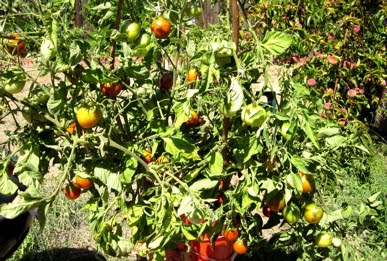
This is a Black Krim in a bucket (I have several plants of this), showing just how heavy the crop can get. Most of these I expect to ripen any day now, and they just keep on going. Ten pounds harvested so far, mostly from 2 plants (the rest were planted later, and in less ideal spots as the ground filled up fast). There is probably at least twice that waiting in the wings, already filled out.


Here is my forest of topsy-turvey planters, showing advantages and disadvantages. First, the one near the front, stitched up with insulating tape, is pretty much on its last legs. Two seasons and thats it. Not exactly the durable UV-resistant material promised on the box. The advantages are that these consistently crop well and are easy to manage - no staking, no crawling into festering jungles to pick. Despite nearly falling apart, this planter with a Red Brandywine has managed 6.5 pounds so far, with more on the way. Thats $20 in the shops folks! Despite all the talk about Brandywines, I haven't yet found a red one that really stands out in taste. The yellows, however, are delicious. Still, the reds are decent enough and give a nice thick, meaty slice.


So here is my main non-hanging tomato paradise - containers sitting on what passes for a lawn in our garden. I'm discouraged from ripping it up and turning it into a vegetable plot, but having plants in buckets soak up the sunshine isnt a problem. I think this is the way to go for now, and every year I plan to expand my bucket collection. The expense is the problem; first, the buckets at about $4 each, then the compost to fill them. Of course, the compost can be re-used and supplemented with home-made. Generally, I fill the buckets half full with my own stuff, then fill up with stuff out of a bag. This too should get cheaper with time, because I plan to throw these in the soil when finished, together with more of mine, and then refill the buckets with the mix for the winter season. And so on. I'll probably keep topping off with commercial stuff because it has wonderful goop in it like bat guano (yum!), but that should get proportionately less every time (depending on how many new buckets I start).


Finally the bad news; here is Hornworm number THREE. These are really difficult to spot. In fact, the damage is what brings them to your attention. They strip branch ends and even attack the tomatoes themselves. Fortunately, once spotted, they arent hard to deal with; squish or otherwise remove as you wish. They get to be the size of your thumb.

Brussels Sprouts planted out

I'm trying to manage the transition between summer and the cool season better this year, so about a month back I sowed some Brussels Sprouts seeds and later pricked them out into pots. So now came the hard part, ripping up crops that are still bearing to make way for something that isnt (yet). Fortunately, the french beans made it easy. They have been pretty much a disaster since the get go, and each plant has produced no more than about 5-10 beans each.


I need to work on why that was (there are several possibilities), but rather than have them take another month to produce one more meal, out they went.


Now there are 16 Brussels Sprouts enjoying the spot, hopefully to do a little better. One of the problems that may have caused poor bean growth is of course that this area only gets about 4 hours of direct sunlight a day, but hopefully, as Brussels Sprouts are a cool season crop, they wont mind too much. The shade will disappear in November when the leaves fall. I still have more plants to deal with, but there are more beans in other spots not doing much :)

The Zucchini have slowed down greatly, and as I used the last of the seed this year, I left one or two to go to seed. They dont appear to be an F1, so the seed should work. Overall, I suspect the slowness of the Zucchini this year is their rotation into the semi-shade beds, but to be fair, I wasn't short of them this year; I gave away two thirds of the crop. I'm beginning to notice some mildew spots appearing, and thats usually the sign of the season nearing an end. Maybe next year I'll try one in a bucket to see how well it does.

The Leeks are still too wispy to think of planting out, but there is plenty of time yet.

Monday, July 25, 2011

Tomato Harvest


Its late July, and finally the tomatoes are coming in in a reliable manner. Serves me right for being tardy in sowing/planting them. Above are the Black Krim that I sowed from seed saved from last year's harvest. Below are some Green Zebra, also from home seed.

Today, I harvested 3.5 pounds of Yellow Brandywine, Green Grape, Druzba (large, but somewhat commercial tomatoes), Black Krim, Mr Stripey, Black from Tula and Green Zebra. In terms of quantity, the Brandywines and the Black from Tula are dissapointing so far, but the Red Brandywine is holding many large green fruit. The Green Zebra were the earliest, with Mr. Stripey, and the Black Krim are just really bearing crops now, a little later, but heavier. Its a little unfair to compare cropping times, however, as the Zebra and Stripey were my first plantings, together with the Red Brandywine.
I'd say that on balance, the Zebra, Krims and Yellow Brandywine of the second sowing are coming in together. Tastewise, I made good decisions. However, I'm not sure Black from Tula will be on my list next year. Druzba is likewise not at the top for taste, but it does have nice, large fruit, and by the looks of it, lots to come.
Japanese Black Trifele had only one fruit so far, but it looks like a good crop is forthcoming.
All the Cherry Tomatoes that I sowed late, are still to ripen, but are looking good at this stage. More anon.
Last years Topsy-Turvey is falling apart at this stage, so I dont think I'll be buying any more. $10 is too much to pay for one year's use, although I did buy two more on sale at half price. The idea is good, and they shade the patio nicely, but something sturdier and cheaper is needed. I'm thinking of painting buckets next year and hanging those. Something else worth trying is planting them upright, and letting the bushes fall over the edge, definitely for the Cherry Tomatoes, which dangle more easily.

Wednesday, June 15, 2011

Summer is starting


Its finally getting hot, and our friends need water. Here is a swallowtail taking advantage of a few splashes. I must remember to splash a little more.

Everything is finally taking off; I'm doing my final harvests on the Fava beans at the moment, both for the table on my second sowing, and for seed on the first sowing. At about 7c per seed, it wasn't really financially viable to keep buying these. But if I can keep some of my crop every year to use as seed for the following year, things should work out. When saving seed, its important to wait until the pod is black and dry (or mostly dry). Next year, if I remember, I'll mix some peas in with the sowing with the idea that the pea tendrils might hold the beans together as a block and prevent them from the odd one flopping around.

The Bush Beans and Runner Beans are starting to come into production, so far it looks like there are no pollination problems, and a bumblebee has found the Runner Bean flowers. However, its been relatively cool up till now, so thats no predictor of summer success. Hopefully the Insuk will live up to its promise and do well in the hot weather as well. Otherwise, I'll have a pretty windowshade, but not much else. Fingers crossed.
Harvesting some lettuce here and there; the small butter lettuce (Tom Thumb) grows and tastes well enough, but it seems to trap a lot of compost/slugs in its leaves and cleaning it is a bit more trouble than other lettuces. I have some "Red Sails" coming in soon with bigger leaves, but after that, its probably the end of lettuce for the season.
The tomatoes are all doing fabulously. Some look stressed (notably "Mr. Stripey", which is very dark with curly leaves), but all are throwing out tomatoes and growing healthily so far. I should be getting the first ones on the table soon, maybe a week or two. I tried one of the "Green Grape" cherries last week, but it was still obviously underripe. Hard to tell on these, hopefully, like "Green Zebra", they'll become apparent when they actually ripen. "Green Zebra"has a nice yellow background to the green stripes when ripe.
The Zucchini are finally into harvest season; I have been taking and cooking 2-inch stubs recently, because they werent growing fast and the plants were just throwing these out 2 and 3 at a time, none of them getting anywhere fast. But now they are settling down and beginning to produce 6-inch ones that expand as normal (Day 1: pollinate, Day 2: to 4 inches, Day 3: harvest at 6 inches in the morning).
Last night I planted out the bean plants in pots, as the roots were bunching up at the bottom of the posts and the first real leaves were unfurling. Hopefully most of the slugs have packed up for the summer. The beans all had problems germinating, but I think I have it worked out; after a couple of hot days I got a flush of new seedlings, so I think they really need heat - say, 65-70 degrees - to germinate. Next year I think I should wait until we have warm weather before sowing. Warm as in impossible-to-stay-out-too-long warm. The garden is finally looking full, now my only question is where the heck do I put my multicolored cherry tomatoes? I sowed them later on a whim, they're planting size now, but not much space available. Under the Runner Beans so they too can climb the wires? Among the roses? Should I harvest the last of the Favas and use that space for 4 of them?

Decisions, decisions...


Going through my phone, I came across this picture of the leek bed in winter. I guess its a reminder to sow leeks for next winter.